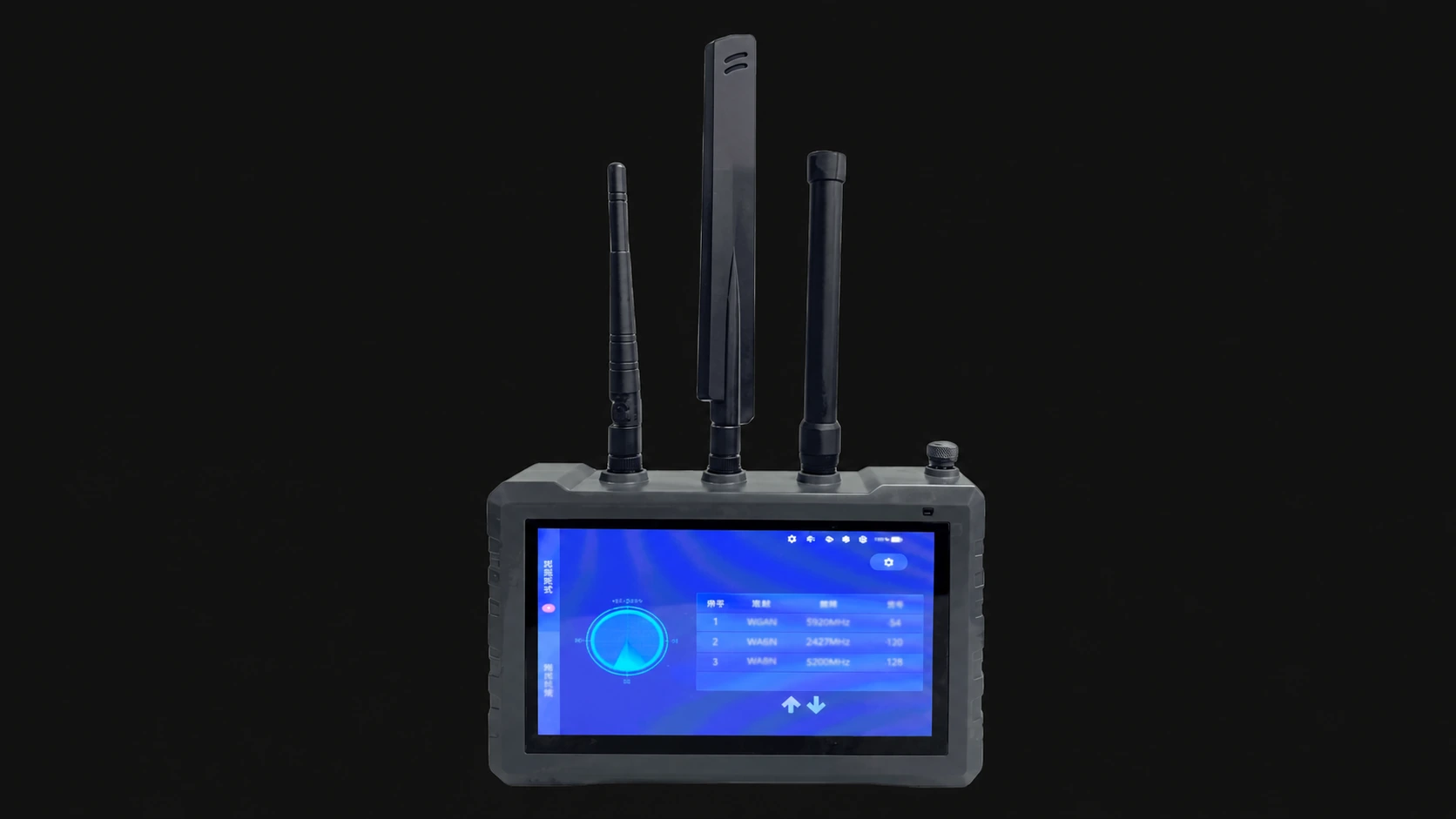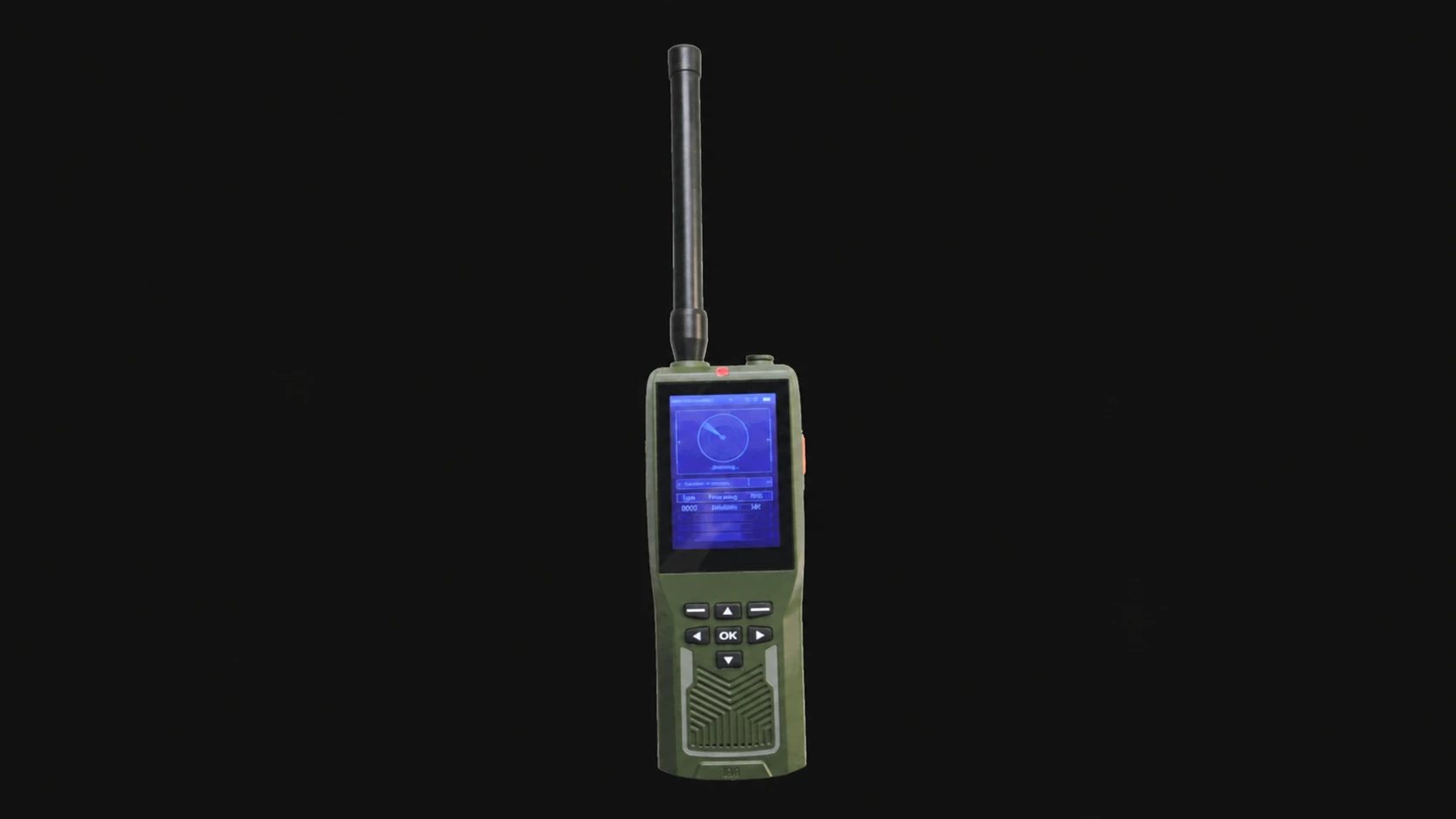
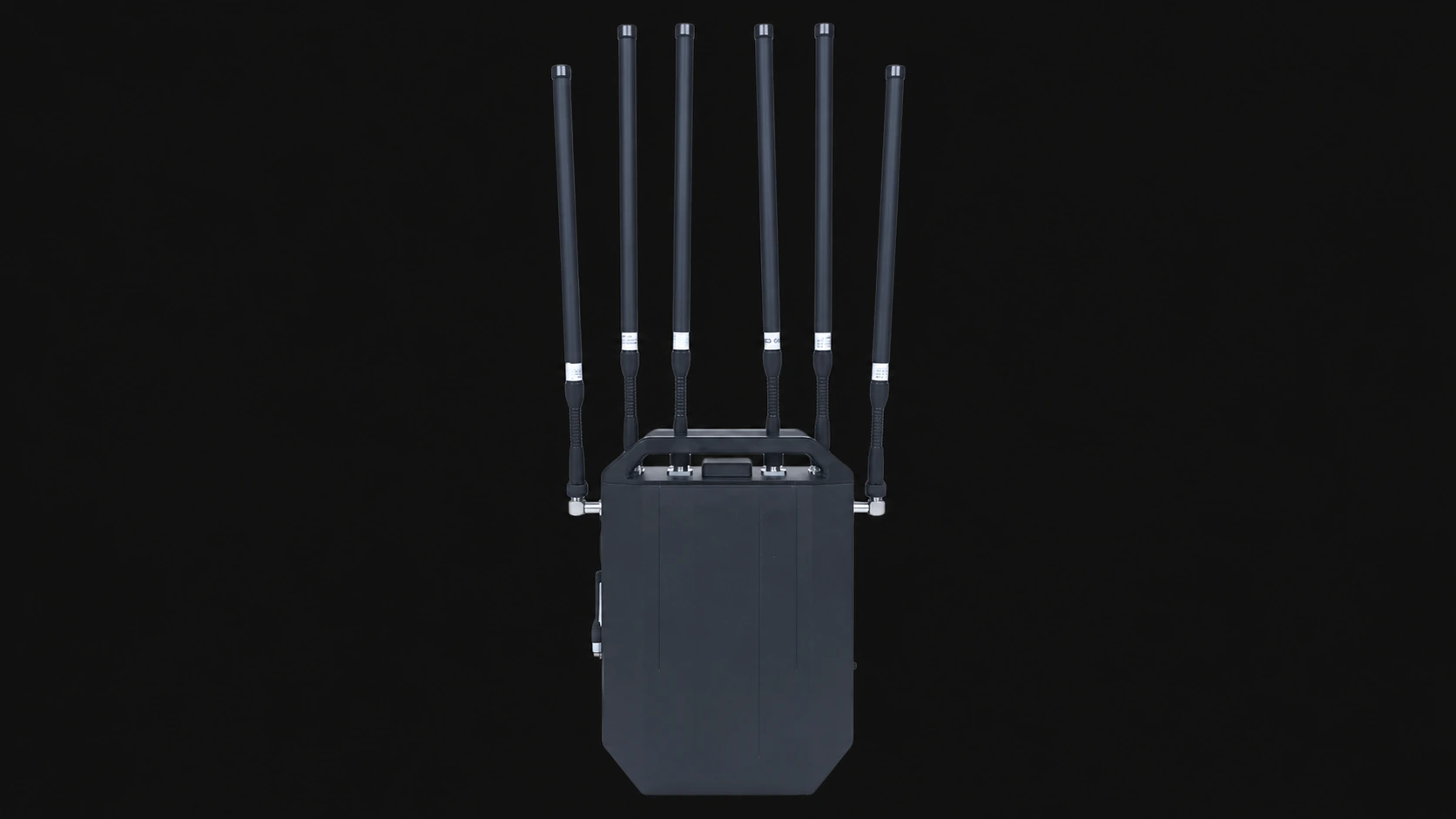
T8000-A
T8000-A detects drone radio signals and captures analog FPV video.
Solution capability. Source illustration; vehicle and device identities are unconfirmed.
Distributed vehicle-mounted capability combining passive RF detection with four separate SDR countermeasure modules and command and control.
Information only.
Introduction As drone technology evolves rapidly, its threat in the military domain is becoming increasingly apparent. Unauthorized incursions by enemy reconnaissance drones, suicide drones, jamming drones and other drones occur frequently, posing serious risks to military operational deployments, the security of military facilities, the personal safety of officers and soldiers, and the confidentiality of battlefield information. As a core platform for applying drone-jamming technology in the military domain, vehicle-mounted counter-drone solutions use the mobility advantages of vehicle platforms and have become a key means for armed forces to address various military drone threats and maintain battlefield security. To address the asymmetric threats posed by drones in modern battlefields and sensitive areas, particularly FPV racing drones with strong resistance to jamming, the supplied document states that its author has developed a vehicle-mounted software-defined radio (SDR) counter-drone system. This system is an integrated, comprehensive defensive equipment system combining advanced radio-frequency technology, intelligent algorithms and high-reliability engineering.
This solution is based on a disruptive smart-jamming concept, completely abandoning the outdated high-power, broad suppression approach of traditional jamming equipment. With software-defined radio (SDR) as its core technology platform, the system performs in-depth analysis of mainstream drone communication protocols, such as ELRS, Crossfire and OcuSync, and can generate precisely matched deception and suppression signals in real time. This achieves signaling-level jamming with the effect of 'using four liang to move a thousand jin', effectively countering anti-jamming measures such as frequency hopping and spread spectrum, and fundamentally resolving the core shortcomings of traditional solutions, which 'cannot jam effectively or accurately' against advanced drones. The solution also uses a modular design that can be assembled without damaging the vehicle body structure and can flexibly accommodate various vehicle types. Solution Design Principles To ensure optimal overall system effectiveness, this project follows the core design principles below: Combat capability first: All design work takes improved countermeasure effectiveness and assurance of victory in operations as its primary objectives. Priority is given to ensuring effective jamming of target drones in complex electromagnetic environments. Technological leadership: Abandon traditional outdated architectures and adopt an SDR software-based architecture and cognitive electronic warfare concepts. A design that decouples hardware and software ensures that the system can continue to evolve through software upgrades, maintain long-term technological viability and respond to continually changing threats.
System compatibility: Treat electromagnetic compatibility (EMC) and electromagnetic environmental effects (E3) as core design constraints. Follow the systems-engineering approach of 'shielding-filtering-grounding-spectrum management' to ensure that the countermeasure equipment operates together with the vehicle platform and other electronic equipment, effectively jamming external targets without impairing its own combat capability. Full-life-cycle reliability: Apply design for the 'six attributes' (reliability, maintainability, testability, supportability, safety and environmental adaptability). Implement comprehensive quality control and ruggedization throughout component selection, circuit design, structural manufacturing processes and software architecture, ensuring that the equipment is highly reliable, easy to maintain and readily supported in harsh battlefield environments. Ergonomics and safety: Apply a 'people-centered' design philosophy. Measures such as a low-radiation layout, directional antennas, clear status indications and convenient operating interfaces minimize the operating workload, protect vehicle occupants and equipment, and prevent operating errors. Modularity and standardization: Use standardized, modular hardware and software interface designs. Support rapid equipment installation, removal and replacement to facilitate iterative upgrades and logistical support, while making adaptation to different vehicle platforms technically feasible and reducing full-life-cycle costs. System Operating Principle
The vehicle-mounted integrated drone detection and countermeasure equipment operates as an electronic countermeasures system whose central feature is an end-to-end closed loop. Its core logic follows strategy instructions issued by the command-and-control system. Through five core stages, wideband signal interception, intelligent identification, strategy decision-making, countermeasure action and effectiveness assessment, it establishes control of the signal links of unauthorized small drones within a specified airspace. This ultimately enables automated, intelligent operation from threat discovery to threat elimination, substantially reducing the time required for human intervention and the level of skill needed for operation, while bringing defensive response times down to seconds to meet the need for rapid action in mobile defense scenarios. The core operating stages comprise wideband detection, intelligent identification and jamming countermeasures. The core function of wideband detection is to capture radio signals within a specified airspace across the full frequency range with high sensitivity. The system is equipped with a wideband reconnaissance receiver module covering mainstream radio-signal bands from 100MHz to 6000MHz, including drone remote-control, video-transmission and navigation signals, as well as other potentially unauthorized radio-signal bands. Multichannel signal-acquisition technology enables simultaneous reception and real-time sampling of signals from multiple targets. Compared with traditional narrowband signal-interception equipment, the system's wideband interception capability prevents missed captures caused by unknown signal frequency bands, while offering a high probability of signal interception and a fast interception response.
The module also combines high-sensitivity signal-detection technology with dynamic gain adjustment, allowing it to capture weak target signals at long distances while avoiding overload distortion from strong nearby signals. This provides complete, accurate signal data for subsequent stages. The intelligent identification stage extracts features from the signals obtained through wideband interception and classifies and identifies them. The system includes a detailed signal-feature database covering remote-control signal modulation methods, such as FSK, GFSK and QPSK, video-transmission signal encoding formats, such as H.264 and H.265, for mainstream drones worldwide, including models from brands such as DJI, XAG and Parrot, as well as signal-feature parameters for FPV drones and others. Using AI deep-learning algorithms and real-time spectrum-signal comparison, the system can automatically extract key features of signals to be identified, including frequency, bandwidth, modulation method and frame structure, and match them against database templates to accurately classify target signals. It can distinguish drone signals from non-drone signals. For mainstream conventional low-altitude, slow-speed, small drone models using protocols, such as those from DJI, it can also use techniques such as DroneID and RID signal-protocol parsing to accurately identify the drone's brand, model and operating status, providing precise information for subsequent strategy decisions. Distributed Vehicle-Mounted Drone Detection and Countermeasure Solution Core Design Concept Figure 3 Deployment Schematic of the Distributed Vehicle-Mounted Drone Detection and Countermeasure Solution 1. The solution uses distributed vehicle-mounted deployment to accommodate various vehicle types. Vehicle integration is the system's basic deployment format, combining passive detection and jamming countermeasure functions.
2. The system uses a distributed modular design to improve deployment flexibility. Its standardized modular design separates core functions, including sensing and detection and jamming countermeasures, into independent modules that can be deployed individually. The detection unit can be positioned at the center of the vehicle roof, while the countermeasure unit's four array faces can be deployed separately around the roof's perimeter. This approach also improves deployment flexibility. 3. A design decoupled from the vehicle platform ensures high feasibility. No major structural modifications to vehicles in service are required. Standardized bracket installation enables rapid adaptation without damaging the vehicle's basic structure or affecting its existing core functions, such as combat and transport, substantially reducing the cost and difficulty of system deployment. 4. SDR technology provides long-term protection and safeguards the investment. The system is built around software-defined radio (SDR) technology and, unlike traditional fixed-band counter-drone equipment, has very strong capabilities for technological evolution and adaptation. As drone technology develops rapidly and communication bands and control protocols continue to change and advance, SDR technology enables a rapid response to incursions by new drone types through software upgrades and parameter-configuration adjustments, without replacing hardware, continuously maintaining the counter-drone system's operational effectiveness. This design effectively avoids equipment obsolescence caused by technological evolution, extends the system's service life, protects the initial investment and ensures stable long-term operation. System Design Figure 4 System Architecture Diagram The system mainly comprises a detection unit and a jamming unit.
The detection unit operates in passive detection mode with an omnidirectional detection antenna. It comprises multiple modules, including the detection antenna, DroneID demodulation module, spectrum AI identification, RemoteID identification and direction-finding unit, and mainly performs wideband detection and intelligent identification. The jamming unit uses directional antennas arranged as 4 array faces in a modular four-face array architecture. The spatial arrangement of four independent jamming modules, with a 90° angle between adjacent modules, provides jamming coverage of the entire 360° airspace without blind spots. Detection Unit Design The detection unit is built around a software-defined radio (SDR) platform and spectrum-identification technology, using a four-face array architecture with independent detection and direction finding. It provides 360° omnidirectional reconnaissance, precise target identification and drone protocol cracking for various types of drones, including remotely controlled aircraft, and also offers high-precision angle-of-arrival (AOA) direction finding. Spectrum-processing performance: The equipment supports wideband frequency sweeping over 100MHz-6000MHz, full-spectrum scanning and anomalous-spectrum analysis. Users can configure custom detection bands according to the actual application scenario. Its interface design is compatible with standard aviation connectors, supporting both independent deployment and integration with a countermeasure system, with highly flexible adaptation to applications. The equipment also includes core functional modules for long-range detection, single-unit localization, drone database upgrades and flight-path playback, effectively broadening its application scenarios and enhancing its practical value.
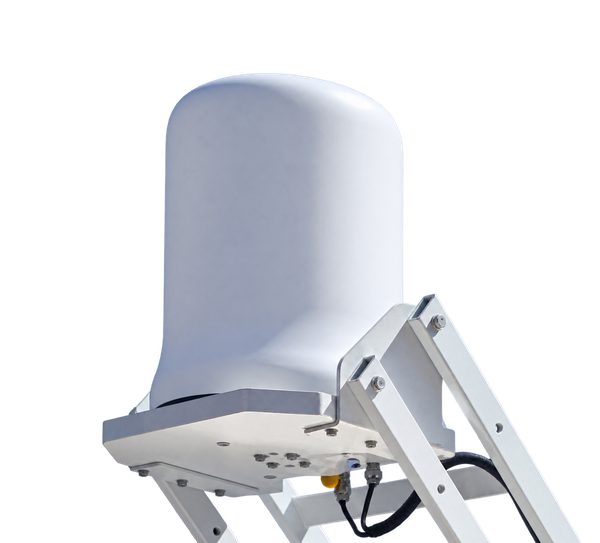
In terms of operating characteristics, the equipment works passively and does not actively emit electromagnetic signals. Its prominent advantages are strong concealment and no electromagnetic environmental pollution, enabling stable operation in complex electromagnetic environments and special application scenarios. Figure 5 Detection Unit Deployment Schematic Countermeasure Unit Design Figure 6 Countermeasure Unit Architecture The countermeasure unit mainly comprises a wiring control unit and four countermeasure modules. The modular four-face array architecture uses a spatial arrangement of four independent jamming modules, with a 90° angle between adjacent modules, to provide jamming coverage of the entire 360° airspace without blind spots, effectively eliminating the airspace coverage gaps found in traditional single-module or dual-module architectures. The main jamming unit focuses on six key frequency bands: 400MHz, 900MHz, 2400MHz, 5200MHz, 5600MHz and 5800MHz. Its coverage includes frequency bands commonly used for remote-control, video-transmission and navigation signals by current FPV racing drones and conventional drones. The 400MHz band corresponds to remote-control signals of some industrial-grade drones; the 900MHz/2400MHz bands cover remote-control and video-transmission signals of mainstream consumer drones, such as the 2.4GHz ISM band; the 1500MHz band targets drone differential-navigation signals; and the 5200MHz/5800MHz bands cover high-definition video transmission and satellite-navigation assistance signals of high-end drones, providing full-band coverage of core drone communication links.
For engineering applications, vehicle-mounted deployment can be achieved using quick-mount brackets. A multilayer drone defense system can be established for key areas such as military bases, airports, fuel depots and large event venues. By effectively blocking drone remote-control, video-transmission and navigation signals, it prevents security threats arising from unauthorized drone incursions and provides a reliable protective barrier for important assets in key areas, such as personnel, equipment and infrastructure. The countermeasure unit uses a modular solution based on SDR technology, with the following features: Dedicated jamming-code generation: Different jamming codes can be output for different brands and types of drones. Parsing of common protocols such as ELRS, Crossfire, Flysky, OcuSync, LightBridge and SyncLeas is supported. Each module has a maximum real-time bandwidth of 200M, with freely configurable power-output frequency bands within this 200MHz bandwidth; full coverage of the 5300M~5950M band (FPV analog video transmission). Low power: Compared with the brute-force suppression effect of high-power VCO technology, precise low-power jamming can be applied to the relevant frequency, achieving the effect of 'using four liang to move a thousand jin'. Frequency-hopping + spread-spectrum jamming: Dedicated spread-spectrum jamming codes can be transmitted randomly over the bands and channels of the FPV control system, and the FPV receiver cannot filter them out through correlation after receiving them. Figure 7 3D View of a Single Array Face of the Countermeasure Unit Figure 8 Countermeasure Unit Array-Face Installation Schematic The countermeasure unit is mounted on the vehicle roof using brackets. The recommended mounting angle relative to the horizontal plane is 65°. Main Technical Specifications Item Specification Description Detection Unit Operating mode Radio detection Detection frequency bands
100MHz~6000MHz Detection direction 360° omnidirectional Detection range* ≥5km (open environment), 3km (urban environment) Direction-finding accuracy 3°RMS (open environment) Jamming Unit Operating mode Radio jamming Jamming mechanism SDR software-defined radio technology Jamming frequency bands 400MHz / 800MHz / 900MHz / 2.4GHz / 5.2GHz / 5.8GHz Defense direction Single face: horizontal coverage angle >90°, elevation coverage angle >60° Four-face arrangement providing 360° omnidirectional coverage Jamming range* >1km (jamming-to-communication ratio 1:1), DIY-FPV (ELRS/TBS Crossfire protocols) >1km (jamming-to-communication ratio 2:1), DJI Mini4 Pro/Mavic 3 Jamming response time <3s Overall Equipment Ingress protection rating IP66 Operating temperature -30℃~+55℃ Main System Advantages Deployment with the vehicle: The vehicle-mounted design supports omnidirectional detection and countermeasures while stationary, as well as dynamic defense while moving, truly enabling 'use whenever the vehicle stops and protection while on the move' Integrated detection and countermeasures: Combines functions such as passive detection and jamming suppression, enabling 5km omnidirectional ultra-long-range detection and 1km omnidirectional automatic defense No particular vehicle type or vehicle modification required: The modular distributed design can be assembled without damaging the vehicle body structure and flexibly accommodates SUVs of various brands Investment protection: The advantages of the SDR architecture allow future algorithm upgrades through software according to actual requirements
Source uncertainty: the descriptive six-band list includes 5600MHz, while its explanation instead refers to 1500MHz; the technical tables list 800MHz and omit 5600MHz and 1500MHz. These distinct source statements remain unresolved. The prose claims detection endurance of more than 8 hours, while the integrated table states 8 hours. The asterisk on detection/jamming range has no explanatory footnote in this document. The source does not define the measurement convention for the jamming-to-communication ratios. All performance and design statements are source claims, not independently verified certification. These entries are solution capabilities, with no confirmed manufacturer or model identity. The shown vehicles/devices are source depictions, with unknown hardware identities. Descriptions of modules, interference methods and nominal mounting angle retain supplied attributes without adding installation or optimization instructions.